
Case study · Ecommerce

Why Shopify and Google Ads disagreed: purchase tracking reconciliation for a South African store

Shopify ecommerce tracking with GA4 and Google Ads, and a careful look at why the store's own order count and the ad-attributed purchases didn't match.

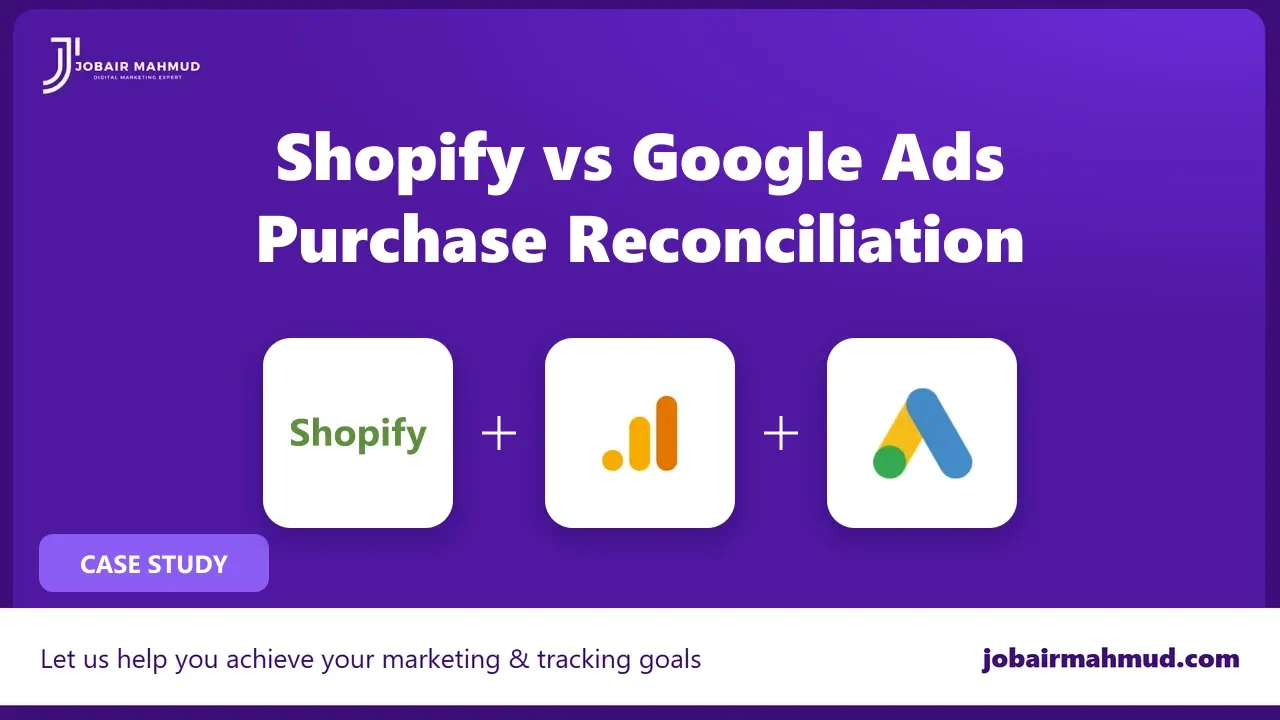
Case study cover: Why Shopify and Google Ads disagreed: purchase tracking reconciliation for a South African store
Client
South African ecommerce retailer
Market
South Africa
Business model
Online store (Shopify)
Platform
Shopify
Period
April 2026 (two weeks)
Scope
Shopify ecommerce tracking, GA4, Google Ads conversion measurement and purchase-report reconciliation

Evidence: this case study is based on my written project notes. No screenshots or client reports are published, so only what those notes record is stated as fact.

01The business problem

The store owner compared Shopify's sales report with the purchases credited to advertising in Google's reports and found a clear gap: Shopify showed noticeably more orders and revenue than the advertising view, and the advertising view even showed a fractional number of purchases.

A gap like that raises an obvious question: is tracking broken, or are the two reports simply measuring different things? The answer decides what to fix, so it was worth answering properly before changing anything.

02Why it was technically difficult

Shopify counts every order the store receives, from every channel. Google Ads counts only the purchases it can connect to an ad click, within its conversion window, and with a data-driven model it can split one purchase between several ads, which is why fractional purchase counts appear.

On top of that, purchases can be missed for technical reasons: a thank-you page that doesn't load the tag, consent declined, a payment redirect that breaks the session, or ad blockers. Separating "different by design" from "missing because something is broken" is the hard part.

03My approach

I treated it as a reconciliation problem rather than a tagging problem. First, line up what each report is supposed to count. Then look for the gaps that can't be explained by attribution alone.

The project covered the Shopify purchase tracking itself, the GA4 setup and the Google Ads conversion measurement, so each layer could be checked rather than assumed.

04How it fits together

  1. Shopify checkout
  2. Google Tag Manager
  3. Google Analytics 4
  1. Shopify sales report
  2. compare
  3. Google Ads conversions
How a purchase travels from the store to the reports (generic labels)

05What I implemented

  • Shopify purchase trackingEcommerce tracking for the Shopify store, so purchases reach GA4 and Google Ads with their value and currency.
  • GA4 ecommerce reportingA Google Analytics 4 property receiving the store's ecommerce events, for comparison with Shopify's own reports.
  • Google Ads conversion measurementGoogle Ads conversion tracking configuration reviewed against the store's purchases.
  • Purchase-report reconciliationA side-by-side comparison of Shopify orders and ad-attributed purchases, to show which part of the gap comes from attribution and which needs a technical fix.

06Testing and validation

The comparison between Shopify's order report and the ad-attributed purchase view is recorded in my project notes. Further test details are not part of the published record.

07Outcome

Delivered

  • Shopify ecommerce tracking for GA4 and Google Ads
  • A documented comparison of Shopify orders and ad-attributed purchases

Verified

  • The reporting gap between Shopify and the advertising view was observed and recorded.

Not known / not published

  • The exact cause of the gap is not confirmed in my records. I don't claim it was lost revenue, recovered revenue or a single tracking error.
  • No change in sales or ad performance is claimed.

08Technical stack

  • Shopify
  • Google Tag Manager
  • Google Analytics 4
  • Google Ads

09Related services

10Go deeper

Jobair Mahmud
Jobair Mahmud

AI-driven Performance Marketing & Web Analytics Consultant · About me

Cross-domain GA4 and consent-aware conversion tracking for a European fintech company
Fintech Europe

Cross-domain GA4 and consent-aware conversion tracking for a European fintech company

One measurement setup across a Webflow marketing site and separate application subdomains, with form events, Google Ads and Reddit conversions, and Consent Mode tied to the consent platform.

Client
European fintech and crypto analytics company
Platform
Webflow, Stripe
  • GA4
  • GTM
  • Cross-Domain
  • Consent Mode
  • Google Ads
Meta Pixel and Conversions API with clean deduplication for ecommerce stores
Ecommerce United States, Netherlands and Belgium

Meta Pixel and Conversions API with clean deduplication for ecommerce stores

Removed an old app integration that sent duplicate events, then rebuilt Meta tracking from browser and server with matching event IDs so each purchase counts once.

Client
Shopify and WooCommerce stores
Platform
Shopify, WooCommerce
  • Meta CAPI
  • Server-Side Tracking
  • GTM
  • Ecommerce Tracking

See all case studies or book a tracking consultation.

Let's Talk

Dealing with a similar problem?

Tell me what you're seeing in your reports. I'll reply with what I'd check first and whether I can help.

or reach me directly